

If you’re wondering why your students perform well on reading tasks but not on listening and you’re sure you’ve covered much of the language in the passage, a big factor is their ability to recognise known vocab through listening.
To achieve this, all vocab MUST be practised aurally, not just through reading and writing tasks.
The tasks below are just a few of the ways you can introduce new vocabulary through listening. Before you begin, each task requires you to have a list of sentences on the topic containing the target phrases you want to teach – you will see what I mean here in the images.
Listening jumble with English and TL
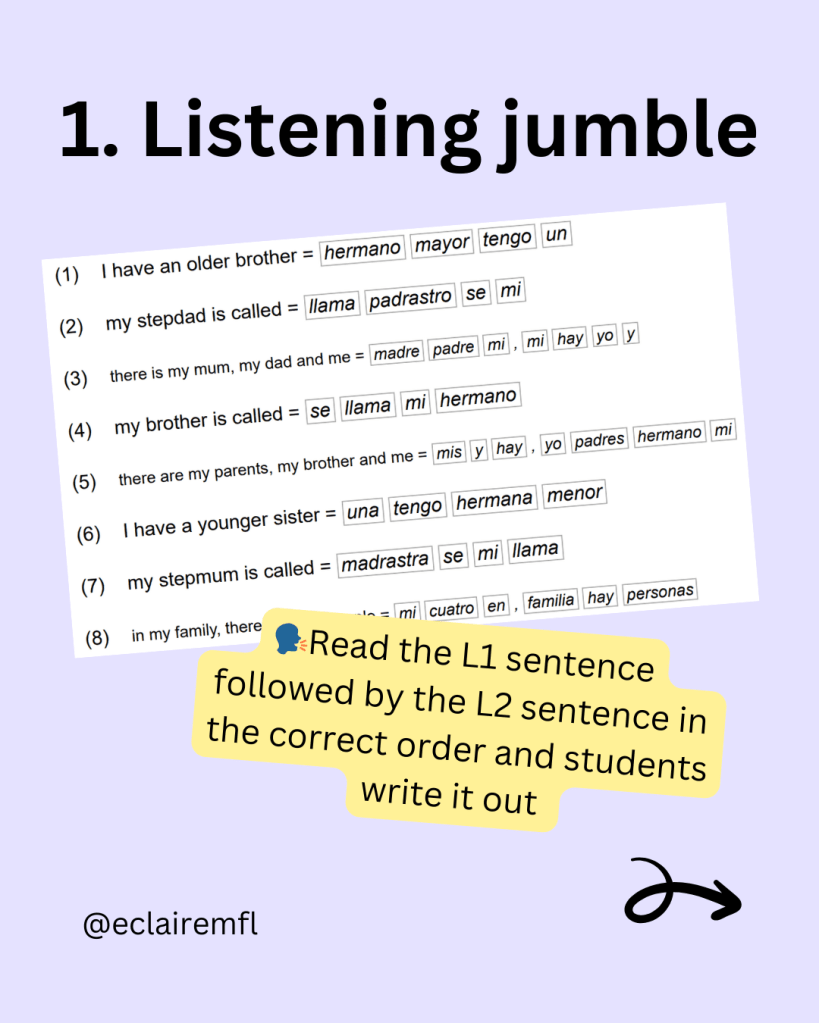
How it works:
- Choose a set of sentences containing the target language phrases or structures you want to teach.
- Use a tool like the scramblinator or ChatGPT to jumble them up – simply paste in your sentences and ask it to jumble them up with a slash between each word.
- On a worksheet, present the original English sentences with the jumbled TL sentence listed below each one.
- Read out the English sentence, followed by the TL sentence in the correct order – students must listen carefully and write out what they hear, using the jumbled words to help with spelling.
Why it works:
✅ Reinforces the connection between L1 and L2 meanings
✅ Reduces cognitive load by introducing new language with L1 available
✅ Students have to hold the sentence they hear in their working memory as they write it down
✅ Helps reinforce word order
✅ Practises spelling
Listening bingo with parallel vocab list

How it works:
- Prepare a parallel list of target language items that students can access – phrases or sentences both work.
- Underneath, give students a bingo grid (either 3×3 for a longer game, or just 4 lines for a shorter version like the image above).
- Students fill their grid using the list, writing the L1 translation in each box or on each line.
- Read out the target language phrases or sentences from the list in a random order.
- Students listen and tick off the ones they hear, aiming to be the first to cross off all the items on their grid.
Why it works:
✅Gamifies listening practice, making it more engaging
✅Reinforces connection between L1 and L2 meanings as students refer to the parallel list to check what they have heard
✅Requires students to hold the sentence in their working memory whilst they try to find it on the list
Listening categories with parallel vocab list
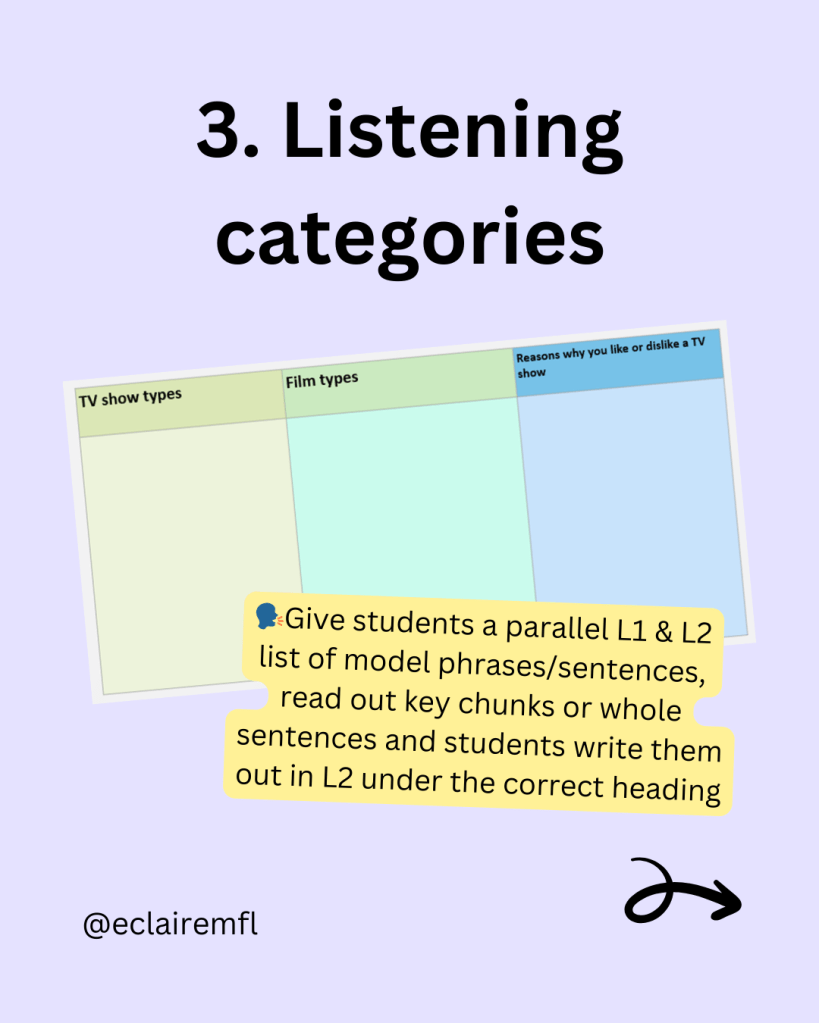
How it works:
- Choose a set of sentences containing the target phrases on your topic. As a whole, they need to contain vocabulary items or phrases that fit into different categories eg. Sentences on the topic of free time could include opinion phrases in the je form, activities, and reasons – these would form the three categories.
- Students have three columns with each of the category titles, and also a parallel list showing the L1 and L2 sentences.
- Read out short phrases from your sentences at random.
- Students must listen, identify the phrase from the list and write it in the TL under the correct category heading.
Why it works:
✅Requires students to hold the sentence in their working memory whilst they try to find it on the list
✅Reinforces L1 and L2 meaning as although students write in the L2 they have to think about the L1 meaning in order to put it under the correct column
✅Practises spelling
By incorporating these activities regularly into your introduction of new language, you give students the ability to recognise it in spoken language – one important step in improving their listening skills!
Do not hesitate to send me a DM on Instagram if you have any questions @eclaireMFL
 eclaireMFL