


In my previous post, we explored how the demands of the stimulus card can be addressed through effective long-term planning and selection of teaching materials.
Before we continue, here is a reminder of some of the common areas where students can struggle in this task:
- Ineffective summarising of the text
- Basic, superficial opinions & difficulty providing justification
- Lack of ideas / repetition / drawing blanks
- Banal, repetitive language / lack of sophistication
- Lack of fluency
In this post, we will look at how we can break down exam technique in lesson activities and offer students effective practice and revision guidance. Here are 9 strategies to tackle the problems listed above:
Do LOTS of modelling
It is time-consuming, but when done effectively, teacher examples can be invaluable for showing students what a good answer looks like. It also puts you in their shoes and helps you identify the specific challenges of the card. Here are some example tasks:
- When students practise the notetaking in the preparation time, set the timer and do the exercise yourself (it really is hard!) at the same time as them, then share and compare notes – this could be done on a whiteboard / with a visualiser / on an inking device connected to the screen
- Provide model sentences/answers for different questions on the card to share with students
- Having done the above, give mediocre example sentences and ask students how they could be improved
- Get students to share their answers and discuss as a group how they could be improved
Use the exemplar material and guidance from AQA (for you, and for the students!)
The AQA website has ‘samples sets’ ie. recordings and transcripts of successful candidates – the discussion of the card and IRP are helpful examples of how these tasks could be approached.
AQA’s guidance document on conduct of speaking exams also gives students a clear idea of how the conversation is organised – their advice to examiners is as follows:
- Stagger the asking of the printed questions across about the first two minutes of the test
- Focus on and follow up student responses to the questions and use supplementary questions
- Explore aspects of the stimulus card that the student may have overlooked
- This will create the unpredictable elements you need
- Having explored the printed questions through follow-up questions and discussion, focus on wider aspects of the sub-theme
I recommend explicitly sharing these details with students and practising this format repeatedly – they will gain confidence from knowing exactly what to expect each time.
Train students to spot several ideas and opinions that arise from a text
I’ve often encountered students claiming they just ‘don’t have an opinion’ on the issues on the text or ‘don’t know what to say in English, let alone in French’ – in my experience, this is because they have only considered the text on a superficial level and struggle to find anything beyond the most salient facts and points in the text. This significantly limits the marks they can get across all areas of the mark scheme; limited ideas = limited language!
For example, let’s consider the card below on youth delinquency – most students will manage to give an opinion on the fact that increasing numbers of young people are imprisoned, probably saying that it is a shame/worrying/sad. However, with modelling and encouragement, they can be trained to comment on plenty of other aspects of the card and to briefly plan these in the prep time. It can be helpful for them to bear in mind the following three themes to guide them in their comments and opinions:
– CAUSES of the issues mentioned, linking to the key context points learned from the study of the topic.
– CONSEQUENCES of the issues mentioned, at an individual and societal level, as well as for different groups involved.
– FEELINGS of the different parties involved, where relevant – a good opportunity for personal opinions, emotions vocabulary, and if clauses, subjunctives etc.
Unfortunately, I have found that the texts the exam boards provide can be a bit inconsistent in that some offer a lot more immediate material than others. But with repeated practice, students can still get better at breaking down a card and identifying possible talking points independently.
See the card below – when we apply the three themes above, working through the text sentence by sentence, students could comment on:
– The fact this is happening in other European countries as well as France – possible causes
– Whether we should be imprisoning minors – how the student would feel if they were a young person imprisoned, how they would feel if they were a parent of a young delinquent, consequences for minors and for prison spaces, effectiveness of prison, alternatives
– Whether the age of criminal responsibility should be 12 or older – to what extent young people are responsible for their actions, other influences on their behaviour eg. parents, school, role of social media etc.

Use sentence builders/knowledge organisers to provide high quality language and structure answers
Students often find it reassuring to have a formula to follow, and some of your multi-purpose phrases can serve as fillers to buy them a few seconds of thinking time whilst they formulate their answer. I use these ones. Some teachers also get students to practise by playing bingo ie. ‘spend’ as many of the phrases from a list as they can in their answers.
Work through lots of topic questions on all themes
Students need the chance to encounter different aspects of the topic to practise giving opinions and finding appropriate material to support their points. Example questions can be sourced from past cards, or you can create your own banks of questions based on the textbook content. Try to link these questions to material they have just seen and encourage them to exploit the examples recently seen in texts. LaProfdeFrançais has produced many example questions and even model answers that may be useful. These can be completed through speaking and/or writing, as homework or divided among pairs in class and fed back to the group.
Help students understand the mark scheme. To score highly for each of the AOs, I encourage students to:
- Show understanding of every aspect of the card – they can do this either by rephrasing different parts of the text, or by referring back to bits of the text in later questions if they did not cover all of it in Q1
- Prepare reactions to several different aspects of the card, as discussed previously
- Get cultural knowledge and examples in there as soon as possible, as time is tight – depending on what questions students get after Q1, topic knowledge can be linked in effectively straight away, and certainly from Q2 onwards. Students should be given the chance to practise this in the prep time
Get students to self-assess and peer-assess against the mark scheme
I find mark schemes often need translating into simpler, actionable pieces of advice for students. You could turn the mark scheme into a checklist so that pupils can practise their answers for cards together and then evaluate their performances against the success criteria.
Incorporate regular, speedy practice of opinions and reactions into reading tasks
Almost any text can be used as a springboard for practising the kinds of opinions and reactions required in the speaking card. This can be a chance to recycle their key sentence builder phrases and apply them to new contexts to develop confidence with the opinion question.
Give students clear structure and specific focus for their revision notes
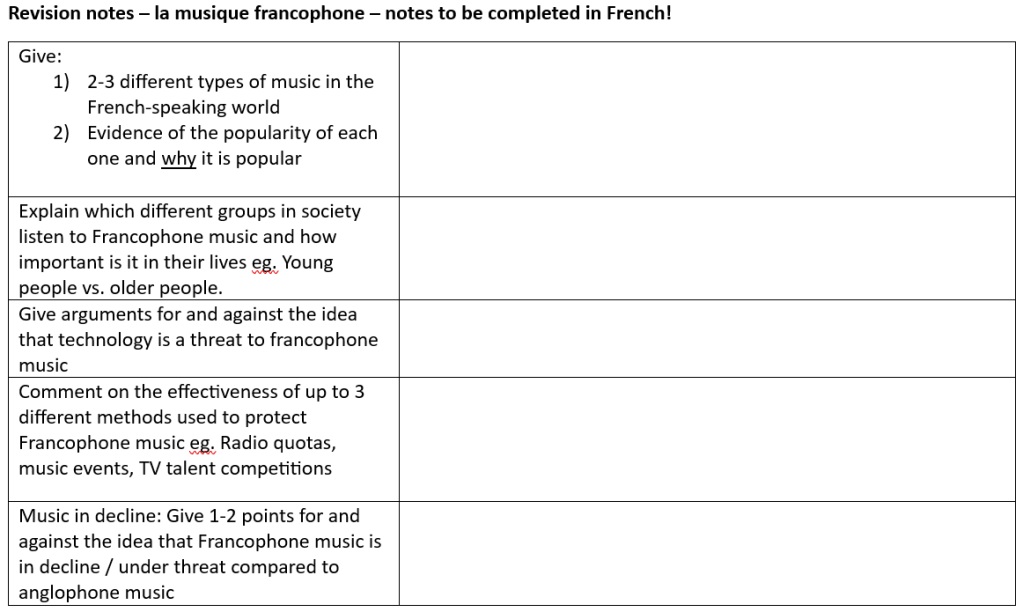
Most students do not automatically know how to write effective revision notes unless given models and very specific prompts. For example, if you just tell them: ‘make revision notes for speaking on the topic of family’, many end up writing down random statistics and vocab lists of single words that won’t necessarily be immediately useful in answering a question on a card or analysing an issue. This year I have started to experiment with giving students very clear and specific prompts for their notes. See the example below on the topic of la musique. I generated these prompts using past card questions and the textbook content.
In summary, through a combination of effective curriculum planning, as outlined in the previous post, and targeted lesson activities that break down exam technique, students can be guided to excel in each aspect of the mark scheme.
I hope you found this content useful – if so, please share, and leave a comment below if you have any questions or ideas to add. Thank you for stopping by!
 eclaireMFL
thanks for sharing your ideas. Are the topic revision sheets / notes available?
thanks
LikeLike
Hi, other I don’t have any of my own yet other than the example above, as the ones I use belong to my school so I can’t share on here. However I do highly recommend the topic revision sheets from laprofdefrancais – if you go on the website she does a bundle of factfiles / topic revision sheets with loads of good content and your students could use those to make their own notes by condensing some of the content. It’s not free but really cheap for what it is in my opinion!
LikeLike
*other than the example above
Sorry posted comment in error before finishing
LikeLike